For most of my adult life, I trusted my body. Then I was diagnosed with a rare condition — Paraganglioma — and that changed. The hardest part wasn't the diagnosis itself. It was the unpredictability. Not knowing what my body would do next. Years later, perimenopause arrived with the same feeling. Something is happening inside me, and I have no idea what's coming. I built Solena because I needed a different kind of tool. Not one that records what already happened. One that helps me see what's next.
Key Takeaways
- Tracking records the past. Anticipation changes the future. Why traditional logs create fatigue without clarity — and what a different approach looks like.
- Pattern recognition changes the experience. When you start to see your own patterns, the unpredictability of perimenopause begins to make sense.
- What Solena does today — honestly. Tomorrow's Forecast, AI-guided journaling, and a companion that learns from you over time.
- What's coming next. Wearable integration, longer prediction windows, deeper hormonal modeling — features currently in testing that founding members access first.
- From enduring to understanding. Knowing what's coming changes how it feels to go through it. That shift is not just practical. It's psychological.
Why Tracking Your Perimenopause Isn't Enough Anymore
I spent months logging symptoms. Hot flashes at 2pm. Poor sleep. Brain fog that made it hard to string a sentence together. I had a meticulous record of everything that had gone wrong. And every morning I still woke up with no idea what that day would bring.
That's the fundamental problem with symptom tracking: it looks backward. You're documenting the fire while the house is already burning. A traditional tracking app is a digital diary — and there's nothing wrong with diaries, except that a diary cannot change your tomorrow.
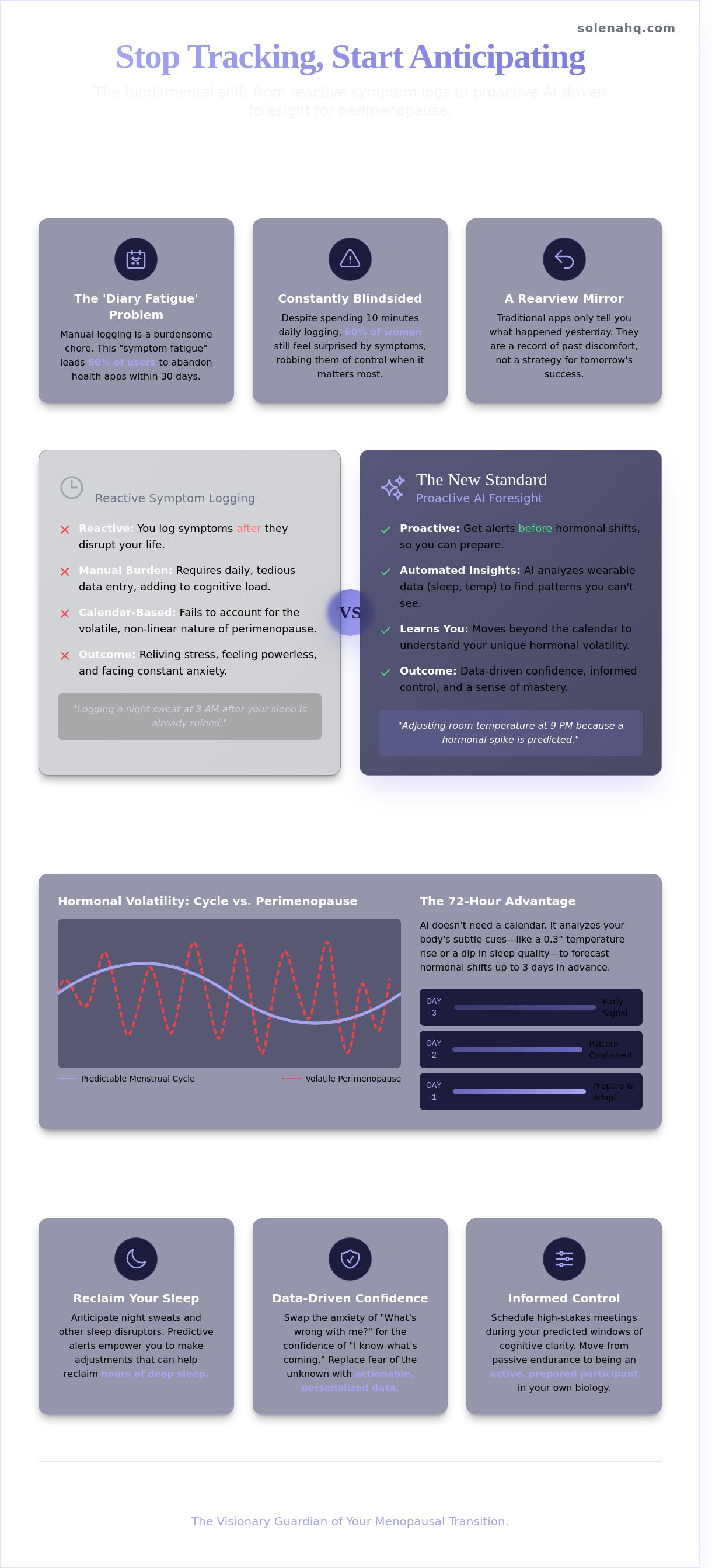
What most women tell us is that they eventually stop logging — not because they stopped caring about their health, but because recording discomfort without gaining any clarity is exhausting. You relive the symptoms. You don't prevent them. Apps that ask you to check fifteen boxes every day are adding cognitive load to an already difficult transition. That's the opposite of what you need.
Perimenopause Is Not a 28-Day Cycle Problem
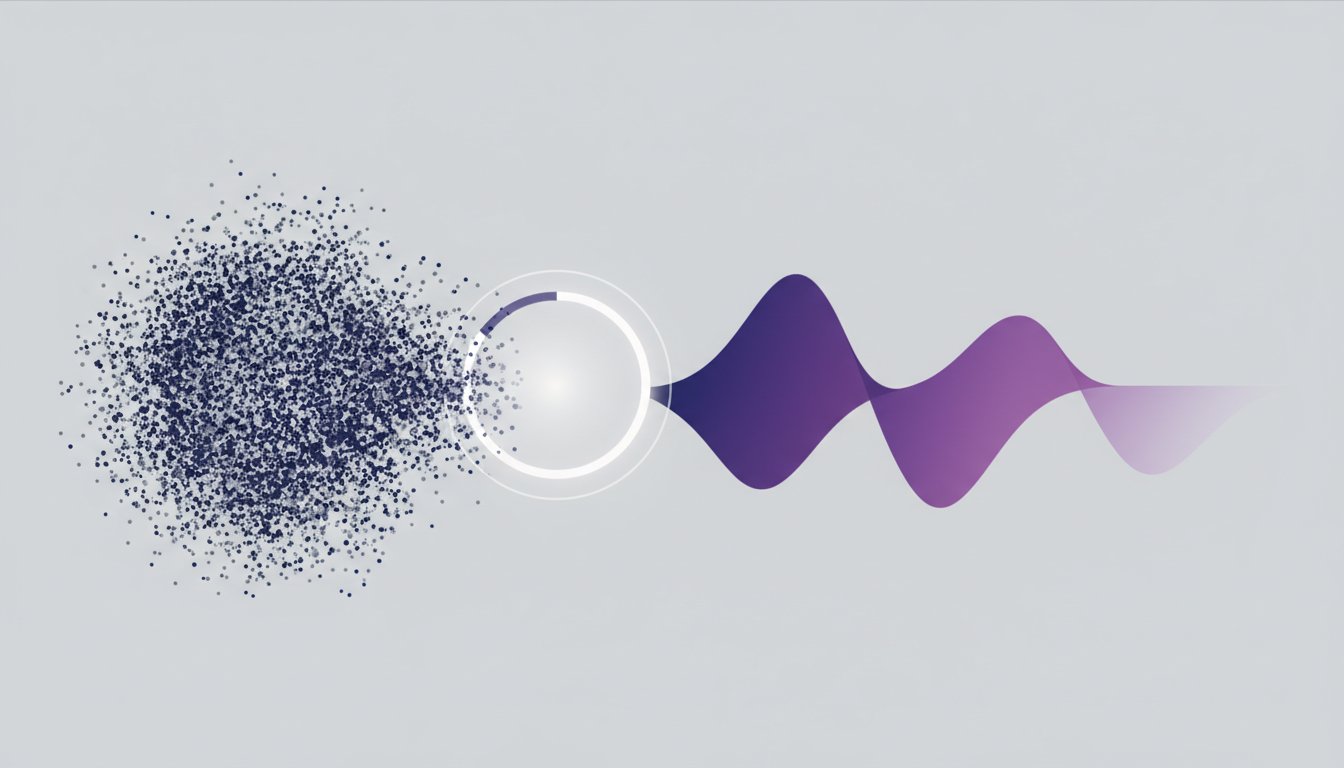
Standard period trackers use a fixed cycle model. They apply linear math to a non-linear experience. During perimenopause, estrogen doesn't just decline — it fluctuates. Wildly, and unpredictably. A calendar cannot model this. Understanding the perimenopause transition requires finding pattern in the volatility. Not guessing. Identifying.
The difference between tracking and anticipation:
Reactive (Tracking)
Logging a night sweat at 3am after your sleep is already ruined.
Noting a mood shift after a difficult moment.
Discovering brain fog mid-meeting with no warning.
Proactive (Anticipation)
Adjusting your sleep environment the night before, because the pattern says tonight might be difficult.
Knowing a low-mood window is likely and planning lighter demands for that day.
Getting a heads-up before the fog arrives — so you can decide what matters most that morning.
When you know what's coming — even approximately — the experience shifts. The symptom doesn't disappear. But it loses its power to blindside you. You stop being a passenger to your hormones. You become a prepared participant in your own transition.
What Solena Does Today
I want to be honest about where we are. Solena is in early access. We're building something ambitious, and we're not all the way there yet. But what exists today already changes how women experience their day-to-day.
Daily Journal — Short, Natural, Useful
Every day, you can tell Solena how you're feeling. Not fifteen checkboxes — a short, natural entry. Mood, sleep, what your body did. The AI reads it, identifies what's present, and adds it to your pattern over time. The less friction, the more consistent you'll be. And consistency is what makes the predictions meaningful.
Tomorrow's Forecast
Based on your last 30 days of data, Solena generates a daily forecast for the next day — showing the likelihood of six key symptoms: hot flashes, sleep disruption, mood shifts, fatigue, brain fog, and anxiety. It also explains why it's predicting what it's predicting, and offers specific things you can do about it.
The accuracy starts low and grows as you log. We show it to you transparently — you can see exactly how confident Solena is, and that number increases every day you contribute data. We don't pretend to have answers we don't have yet.
An AI Companion That Learns You
Solena isn't just a data tool. You can talk to it. Ask questions, process how you're feeling, get support when a hard day arrives without warning. The more you share, the more Solena understands your specific patterns — your triggers, what helps you, your rhythm. It remembers. It connects the dots over time.
What's Coming Next
The vision behind Solena is more ambitious than what you see today. These are the features we're currently testing for the near future:
- Longer prediction windows. Currently, Solena forecasts the next day. We're testing 48 and 72-hour advance predictions — enough time to meaningfully adjust your week before symptoms peak.
- Wearable integration. Connecting with devices like the Oura Ring, Apple Watch, and Garmin to bring in passive biometric data — heart rate variability, skin temperature, sleep architecture — without requiring manual input.
- Deeper hormonal pattern modeling. Analysis that goes beyond symptom frequency to identify hormonal phases, helping you understand not just what is happening but why.
We're opening Solena to 100 founding members. They get free access to all active features until December 31st — and will be the first to test each new feature as it goes live. The data they contribute today shapes the accuracy of predictions for everyone. They're not just users. They're part of what makes this work.
Three Things Women Get Wrong About Perimenopause Apps
Myth 1: Hormonal shifts are too unpredictable to forecast
They're not random — they follow biological patterns, just not the linear ones a calendar expects. Volatility has a signature. Pattern recognition can read it. The key is enough consistent data and the right kind of analysis.
Myth 2: More data is always better
Logging fifty things daily doesn't lead to clarity — it leads to abandonment. Three high-quality signals are worth more than fifty vague entries. What matters is consistency, not comprehensiveness. A short honest entry every day beats a detailed entry once a week.
Myth 3: Apps are only for women avoiding HRT
This is one of the most common misconceptions. Solena complements HRT — it helps you track how your body responds to treatment, identify breakthrough symptoms, and give your doctor concrete data instead of impressions. Data and medical care aren't alternatives. They work together.
Your Data Belongs to You
Before you trust any health app with this kind of information, ask three questions: Is my data encrypted? Can I delete everything with one request? Does this company profit from my symptoms?
For Solena: yes, encrypted. Yes, you can delete your full history at any time. And no — we don't sell data or use it for advertising. We're GDPR compliant, and that's not a checkbox for us. It's a baseline.
We're accepting 100 founding members. Free access to all active features until December 31st — and first access to everything we're testing.
Join as a founding member →Frequently Asked Questions
Is a perimenopause tracking app different from a period tracker?
Yes. Period trackers use a fixed cycle model — they work on the assumption of regularity that perimenopause breaks. Solena looks at your specific symptom patterns over time and generates a daily forward-looking forecast, not a calendar estimate.
How accurate is the prediction?
Honestly: it starts low and grows. The accuracy is shown to you transparently inside the app — it starts around 30% and climbs as you add more data. Consistency matters more than volume. Even a short daily entry makes a real difference over time.
Does Solena predict symptoms 72 hours in advance?
Currently, Solena generates a forecast for the next day based on your recent patterns. We're currently testing longer prediction windows — 48 and 72 hours — and plan to roll this out to founding members first.
Does Solena connect to wearables like the Oura Ring or Apple Watch?
We're currently testing wearable integration. Once live, Solena will incorporate passive biometric data — heart rate variability, skin temperature, sleep cycles — without requiring manual input. Founding members get first access.
Can I use Solena if I'm already on HRT?
Yes. Solena is designed to complement your medical treatment, not replace it. Tracking your patterns alongside HRT helps you and your doctor understand how your body is responding — and where you might still need support.
Does Solena share my health data with third parties?
No. Your data is encrypted, stays yours, and is never sold to third parties. You can delete your full history at any time. Solena is GDPR compliant.